
From Thought to Screen, With Nothing in Between
THE SETUP
AI video crossed a threshold this year. The tools stopped behaving like novelties and started producing work that holds at a cinematic scale, provided someone with judgment is operating them. Most of the industry responded by talking about it. I wanted to know where it broke. So I built a brief around the hardest constraint I could impose: make something cinematic, emotionally resonant, and unmistakably brand-aligned, using only AI generation and post-production. No camera. No crew. No stock footage. Sixty seconds, start to finish.
Colosseo is expanding into AI-driven production, and there is a version of that expansion in which the client project quietly becomes the test case. I have no interest in that version. Finding the ceiling of a tool, and the precise places it fails, is work that belongs on my time and my budget rather than someone else's. By the time these tools reach a client engagement, the failure modes should already be known, mapped, and designed around.
One decision shaped everything after it: I wrote the outline of this case study before generating a single frame, which meant knowing from the start which problems were worth fighting through and which were worth abandoning. The story came before the footage.
The tools are available to anyone. What you point them at is the work.
The renderer generated frames. It did not decide what those frames should contain. The shot list, the three-act structure, the choice to let an evening pass through a detail shot of accumulating bottles rather than a caption, the decision that the guitarist should be the quiet one until he is not: none of that came from a tool. The technology changed the cost of executing the vision, not the source of it.
The Distance Between a Bonfire and a Brand
Phase One - Listen
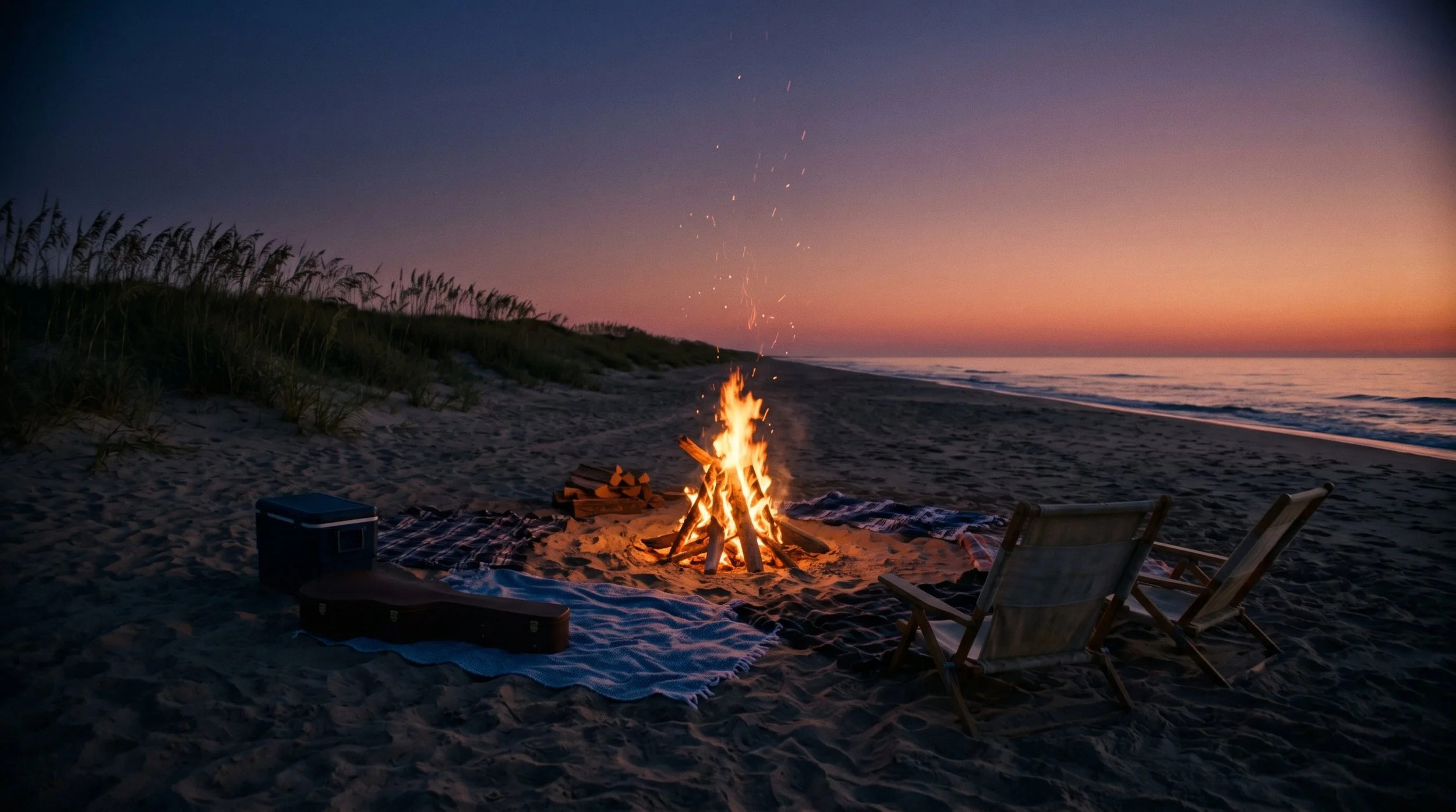
The concept arrived early and never really left: friends gathering on a beach at dusk, an evening unfolding around a fire, a sky opening up at the end. Storytelling rendered as a literal act. What made me hesitate was distance. A viewer has to travel from "friends on a beach" to "branding studio" across several cognitive leaps, and as direct-response advertising that distance is a liability. What resolved it was recognizing the film does not have to do the explaining. Its job is to make somebody feel something for sixty seconds; this case study does the rest.
From there the direction was specified down to its texture, because in AI production specificity is the only steering wheel you are handed. Three acts across sixty seconds: an arrival through empty dunes at golden hour, a gathering that deepens as the light drops and the fire takes over, a final pullback into a sky wide enough to end on. Three recurring characters, cast and dressed with the renderer in mind as much as the story. The lead's cream linen button-down was a production decision before it was a styling one, chosen because a clear silhouette and a visible texture survive from one generation to the next in a way that a plain t-shirt does not. The color grade was mapped to the emotional arc in advance: desaturated and quiet on the open, saturated and amber-rich through the middle, cool and spent at the close. No dialogue. No voiceover. The film would have to carry itself on image and music alone.
Where the Renderer Has Opinions
Phase Two - Build
The stack. Video generation ran primarily on Google Flow using Veo 3.1, which handled physical realism and natural human movement more reliably than anything else I tested in outdoor settings — exactly what this concept required. Its Ingredients system, which locks reference images for characters and settings so they can be reused across generations, became the backbone of the consistency strategy. Certain shots were generated in Kling instead, both to cover the moments where Veo could not quite get the job done and to see how a second renderer handled the same material. The references themselves were built in Nano Banana 2, which in testing held resemblance across multiple images and multiple subjects at once — precisely what a recurring cast of three demands. Music was generated in Suno. Assembly and the closing card were built in After Effects.
The reference layer.
The first real work was building the cast and the world before any video existed: five reference sets, three characters and two empty settings for the dune path and the bonfire, which became the Ingredients loaded into every generation that followed. This was the smoothest phase of the project. Images generated quickly and cheaply enough for genuine iteration.
The harder discovery came next. Text prompts alone could not reliably control camera angle or composition. The establishing drone shot was the tell: however the prompt described altitude, the renderer kept reading "aerial" as a low crane rather than true drone height. The fix reframed the whole production. Instead of describing the shot, I generated a still at the exact camera height and angle I wanted and fed it in as the first frame, leaving the text prompt to handle motion and nothing else. Lock the composition with an image, then let language do the one thing language is good at. That technique carried most of the film's more demanding shots.
When the renderer fought back.
AI video generation is not push-button filmmaking, and this case study would be worth very little if it pretended otherwise. Most usable shots took several attempts. A few took many.
One recurring failure I came to think of as Ingredient bleed. In the arrival shot, the entire background group setting up around the fire rendered as copies of the protagonists: same hair, same clothing, same build. The character references were leaking into every human figure in frame. The fix was to write difference explicitly into the prompt, assigning the background crowd their own clothing, hair, and accessories until they read as separate people.
Other problems were solved by moving the camera rather than fighting the tool. The pair kept rendering with their backs to the fire when the prompt placed the fire behind them, so I moved the camera to the fire's side and shot through the flames, which made facing the fire identical to facing the lens. When a character needed to run up from behind, the renderer insisted on placing the active figure nearest the camera, so I put the camera behind her and let her run away toward him. The tendency was not a bug to defeat. It was a current to steer with.
The most stubborn shot in the film was a guitar being lifted out of its case. Attempts produced two different sets of hands, a fire that materialized out of nothing, and a guitar that bent and levitated as it came free. The multi-step fine motor action was simply past what the renderer could hold together. The solution was not more attempts but a smaller ask: the shot now shows only the case being flipped open to reveal the guitar inside. It never leaves the case on camera. The next shot shows him playing, and the viewer's mind closes the gap without noticing there was one. That was the pattern underneath all of it. When the renderer resisted a detail, the answer was to simplify the ask, and the story survived every cut intact, which is a direct way of learning the detail was never load-bearing.
The consistency problem.
Holding three characters steady across dozens of generations — fourteen of which made the final cut — was the largest risk in the project, and it was handled in the creative direction long before it became a technical one. I did not keep a tally, but the character references held their likeness roughly four times in five, and the shot design was built to absorb the rest. Dusk, firelight, and a night sky obscure fine facial detail by nature, so the film leans on silhouette and backlit framing and keeps close-ups scarce. The setting, rather than any single face, is the constant the eye anchors to, and cutaways to hands, bottles, and the fire carry no consistency risk at all while bridging any continuity jump. What remained was handled the old way: choosing the best of several generations and cutting around the rest.
The assembly.
Fourteen clips, each generated at eight to ten seconds and most of them trimmed to a fraction of that, were stitched into a single sequence. The brief said sixty seconds; the film runs sixty-eight. The picture itself lands close to the mark — the overage is the closing card and the music being allowed to finish rather than cut short. Generating long and keeping only the best few seconds turned out to be its own form of insurance: within any given clip there was usually one stretch where the faces held and the physics behaved, and the edit only needed that stretch. Very little correction was needed there, because the look had been specified at the prompt level rather than fixed afterward. Audio was a judgment call. The ambient sound generated alongside the video is passable, and it stayed in the cut, but it sits far down in the mix under the music rather than carrying anything. It is texture, not story. The music was generated to follow the same three-act arc as the picture, and once the track existed the film was re-cut to it so the edits land on the beats. The music leads and the edit follows.
The ending went through a late revision worth recording. The original plan called for an animated constellation resolving into the Colosseo mark, drawn as thin connecting lines across the star field. It would have been beautiful and expensive, and at a certain point the honest calculation was that the film did not need it. What replaced it is simpler: the sky holds, the music arrives at its peak, and the mark resolves on the beat. Restraint was already the governing principle of the ending. Cutting the constellation applied it one step further.
What the Experiment Leaves Behind
Phase Three - Sustain
The most useful thing to come out of this project is the part that transfers. What the film produced, beyond the film, is a repeatable method: the reference-and-first-frame workflow, the framing strategies that absorb inconsistency, the practice of simplifying an ask until the renderer can meet it, the discipline of cutting to generated music. None of that has to be reinvented on the next project, and it can be run on someone else's deadline.
What Changed
The Proof Is the Film
Sixty-eight seconds. No camera, no crew, no stock footage — every frame generated.
This started as an internal project in service of my own marketing, and on paper that is all it was. What came out of it is larger. A capability that used to be described can now simply be shown, and the outer edge of what these tools can do today has been found by pushing until they gave, which is the only reliable way to find it. I know where the ceiling sits, which asks are worth making and which will burn a budget for nothing, and what separates a shot the technology can carry from one it will quietly ruin. That did not come from a demo reel. It came from spending the credits and hitting the walls.
It is worth being plain about what those tools could not do, because the limitations are part of the proof. Most of the generated footage carries a visible watermark, and I left it in place. Removing it cleanly is frame-by-frame work, and for a conceptual film made to prove a point rather than sell a product, that was not a defensible use of the hours. The Kling shots do not carry one. Underneath all of it sits a digital fingerprint that cannot be removed at all, which I would not want removed regardless: the film is AI-generated and it should say so. Character likeness held about four times in five, as described above, and the rest was managed through shot selection and editing rather than anything clever. The ambient audio was never strong enough to carry the film, and the music that does carry it holds a commercial license whose copyright standing, like most AI-generated work at this moment, is not fully settled. None of that diminishes the result. Pretending otherwise would.
What this took was not a camera or a crew. It was judgment: about which concept could survive the medium, which details to defend and which to release, and which of many imperfect generations was the one worth keeping. The tools are available to anyone. That part is not.
The film ends on a sky too full to count. Every point of light up there is a story that has not been told yet. Yours is one of them.
What’s Yours?
This was my story.
Ready To Get Started?