
Case Study
Neal Glatt Sales & Strategy
Your Designer, Encoded: Staying On-Brand in the Age of AI
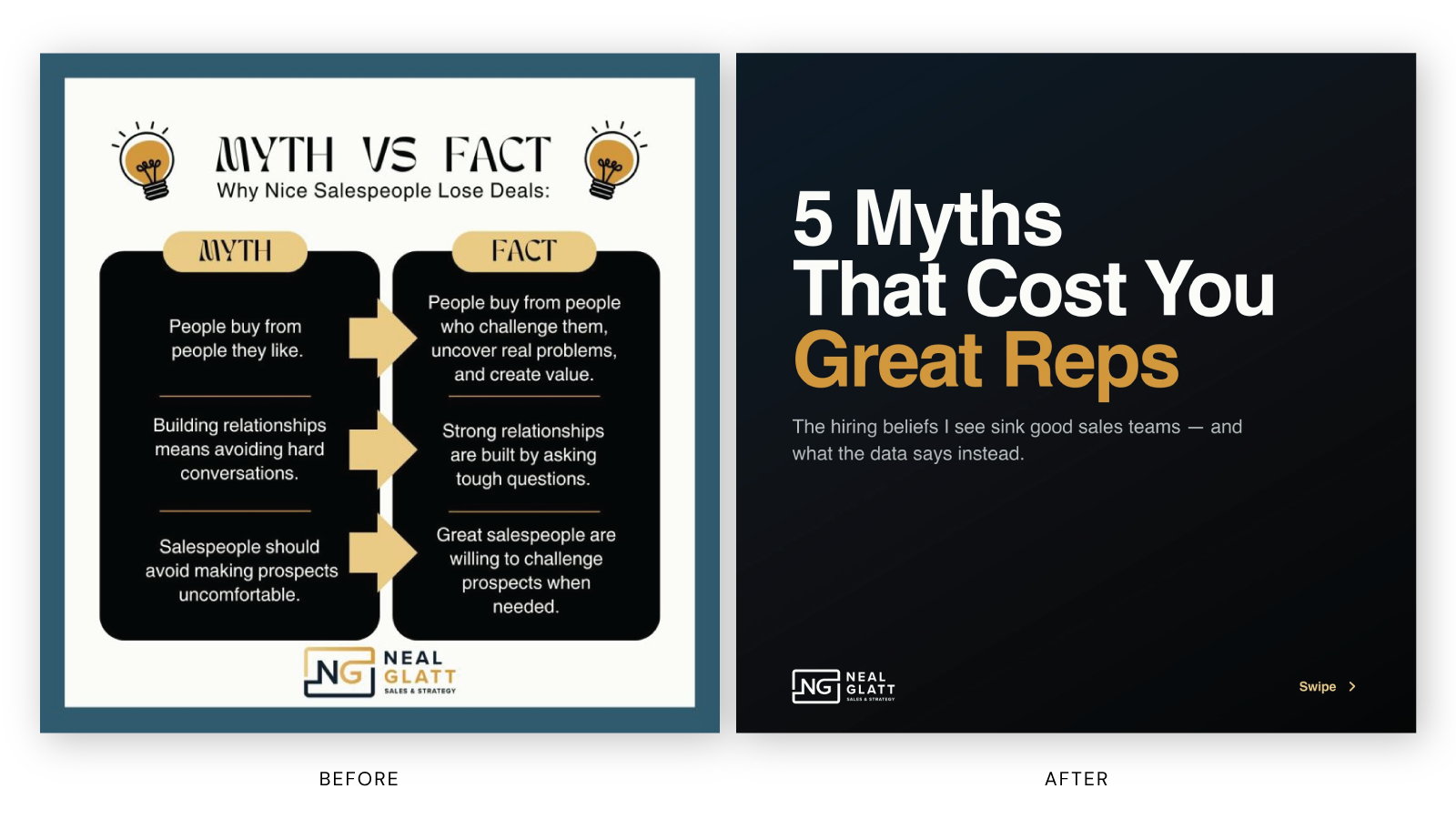
Off-Brand by Default
The Situation
Most companies do not have a branding problem. They have a consistency problem. The logo is fine. The colors are chosen. Somewhere there is a website that looks the way it should. Then the actual work goes out the door, a LinkedIn post, an email, a one-off graphic, and none of it quite matches. Different fonts. Slightly wrong spacing. A voice that shifts depending on who happened to be writing that day. The brand exists. It just does not show up the same way twice. Neal Glatt Sales & Strategy had exactly this problem, with a modern accelerant.
Neal runs a data-driven sales hiring and strategy practice with an established reputation and a client base that trusts him. Colosseo had already overhauled the brand and built the website. What did not exist yet was any documented system behind it. No style guide, no single source of truth, nothing that defined the brand anywhere except in the work itself and in Neal's own instincts.
The deeper issue was that the work would not hold still. A growing company cannot predict what it will need to produce next month: a client proposal, a one-page leave-behind, a slide deck, a run of social posts, a request that has to look polished by Friday. The volume and the variety both keep climbing, and almost no company of this size can justify a full-time designer to absorb it. So the work scatters. It lands wherever there is a free hand, and that hand is rarely a designer's. The brand was a real investment. What it lacked was a way to make that investment carry through everything produced after it, by anyone, on any given day.
The accelerant was AI. Neal and his team had started producing much of their content through AI tools, and the output kept drifting off-brand in small but compounding ways. Colors landed slightly off. Spacing went inconsistent. Type sizes wandered. The copy carried its own tells too, the ones anyone who has watched an AI tool write marketing material will recognize: a reliance on certain punctuation, decorative formatting, the small habits that quietly signal a machine wrote this. None of it was wrong enough to notice in isolation. All of it together read as off-brand, and it was making a sharp company look less polished than it was.
The ideas underneath were sound. The surface was betraying them. The brand was strong everywhere except where it was being produced fastest.
So the real question was never "make a style guide." A style guide lives buried in a brand folder, opened once and forgotten. The question was sharper, and I had not seen it answered well: how do you let people who are not designers operate a brand through AI tools, have it stay on-brand, and not require a designer to review everything that goes out?
The brand had a clear identity. What it lacked was a way to make that identity survive contact with the tools producing the work.
Reading the Brand That Already Existed
Phase One - Listen
This phase looked different from a typical engagement. There was no blank page and no discovery sprint to run. The brand was already in the world: a website, a slide deck, a logo set, the full body of existing collateral. My job was not to invent. It was to read.
So I went through everything that already existed. I read the live site closely. I examined the deck. I inspected the logo files and the other existing collateral. The goal was to extract the brand that was already being expressed, the positioning and the voice and the visual logic, rather than to interview it into being. I had built the original brand, and Neal trusted me to carry it forward, so this phase was largely mine to run. Where something could be answered from the work, I answered it. Where it could not, I left it blank rather than guess, flagged for a later review. The team and I worked through the early outputs together as they came, and that is where the real calibration happened.
There was a limit worth naming. I was codifying what existed, not documenting something that had been formally validated. The brand had been built and lived in, but its positioning and voice had never been put through a discovery process and proven on paper. That distinction shaped every decision that followed. A source of truth is only worth building if it tells the truth, including the truth about what it does not yet know.
A Living Document
Phase Two - Build
On paper, the deliverable was a document. But the format was a decision in itself. Instead of a designed PDF that looks finished and updates slowly, I built it as a plain markdown file: fast to revise, and readable by any AI tool the team might reach for. The same source of truth could drive one tool today and a different one next year without being rebuilt. That was the point. The goal was a brand that applied itself across whatever the team used, not a guide chained to a single app. And it was built to keep growing. The system moved through seven versions, each driven by something real that surfaced when the brand met a tool. Text came out too small on a graphic, so the type scale got specified. Headlines broke across awkward lines, so line-break rules went in. Logos failed in handoff, so file-preparation guidance was added. None of that was the system failing. That was the system doing its job.
The Foundation.
The first work was to pull positioning, voice, and the visual system out of the live assets and write them down in one place for the first time. But the most important decision in this phase was a decision not to write something.
Two slots, the tagline and the anchor quote, I left intentionally blank, with notes explaining why. I could have generated both. An AI tool would have produced a plausible tagline in seconds, and it would have looked right. But no discovery had been done to earn one. Inventing it would have hardened a guess into a fact, and because the whole purpose of the system was to feed every downstream tool, that guess would have propagated everywhere, treated as true by every instance that read it. An honest blank beats a plausible invention. That principle became the spine of the system.
The Voice.
The clearest read on Neal's voice came from the smallest artifact. On his thank you card, he had chosen "Deeply Grateful" over "Thank You." That one substitution told me more than a brand questionnaire would have. His voice is not metaphor and it is not poetry. It is plain language, lifted by a single precise word.
From that, I built a two-register voice system. The default is direct and operational, the way the practice actually talks about hiring and sales, roughly three-quarters of everything. The second register is the accent, used sparingly for moments of impact: plain, punchy, imperative pairs like "Stop guessing. Start growing." Never decorative, never metaphorical. Elevated, but still plainspoken.
Then I did the part that mattered most for an AI-driven workflow. Rather than only describing what good looked like, I documented what off-brand looked like, the specific habits that had been creeping into the output, and paired real before-and-after examples side by side. Those pairs turned out to be the single most useful thing in the document. An AI tool does not learn a voice from adjectives. It learns from examples of what to do and what never to do.
The Visual System.
The visual system followed the same logic, and it taught me the lesson that reshaped the project. Early versions described the visual brand the way brand guides usually do, with ranges and baselines and reasonable-sounding guidance. That was a mistake, though I did not know it yet.
There was also a stubborn, concrete problem to solve. The logos kept breaking inside AI tools. Vector files were stripped of their color, print files were re-traced into something distorted. The fix was unglamorous and entirely transferable: export the artwork so the color is written directly onto it where nothing can strip it, outline the text, keep the print formats for print only, and supply plain fallbacks. A small detail, and the kind that separates a system that works from a document that only describes one.
The Reconciliation.
The turning point came when I reconciled the brand system against a design-system artifact that had been built separately from it. The two should have agreed. They agreed on almost nothing. Type scale, spacing, corner radius, even the fonts had quietly drifted apart. One thing held perfectly: the color palette.
The palette survived because it was six exact values, each named, none open to interpretation. Everything that had drifted was something I had left as a range, a baseline, or a silence. That was the lesson, and it was larger than this project. Specificity is what survives. Vagueness gets re-invented, slightly differently, by every tool and every person who touches it. So I went back through the system and resolved everything the way the palette had been resolved: exact, named, closed sets, with an explicit instruction to the AI tools to use only what was defined and never to invent the rest. The blanks stayed blank on purpose. Everything else got pinned down.
Built to Stay Current
Phase Three - Sustain
The real test of a system like this is whether it survives past the engagement. This one was built to.
The system is versioned, now in its seventh iteration, covering the brand's foundation, voice, visual system, and the operating instructions that tell AI tools how to apply all of it. Around the document sits the part that keeps it alive: a protocol that holds the various tools in sync as the brand evolves, a visual style guide for the moments when a person needs to see rather than read, and a standing six-month review where I sit down with the team to update the system against how the brand has actually been used. It is not a file they were handed and left to manage alone. It is something we maintain together, designed so the brand stays current instead of slowly rotting the way an unmaintained guide does.
This matters more as the practice grows. A company with a team behind it needs a consistency that cannot depend on any one person holding the pen. The system is what lets the brand scale without losing what makes it Neal's. The honest blanks are still there too, waiting for the discovery that will eventually earn them.
The Quiet Kind of Proof
What Changed
This is not a case study with a dramatic metric attached, and I am not going to invent one. The system was built to govern consistency, not to move a conversion number, and the honest outcomes are the ones that match what it was for.
The team produces content through AI tools and stays on-brand doing it. Neal and his team have said the work coming out of the system is better than what they had before. The output stopped reading as machine-made. The drift that started the whole engagement was caught, corrected, and then guarded against. The logo failures were diagnosed and resolved. And the brand finally has what it was missing at the start: a single source of truth the team can operate day to day, with me alongside them for the larger updates rather than gatekeeping every one. Whatever the company needs to make next, a proposal, a deck, a one-off graphic, it now starts from the brand instead of guessing at it.
Consistency used to depend on who was holding the pen. Now it depends on the system. And the system remembers every decision worth keeping.
There are no engagement or revenue figures here, and that is the right place to land. A system whose founding principle was that an honest blank beats a plausible invention would be a strange thing to dress up with manufactured numbers. If real metrics surface as the brand matures, they will be earned. For now the proof is simpler. The brand shows up the same way twice.
Set the guardrails once. Let the tools do the work. Keep the brand yours.
What’s Yours?
This was their story.
Ready To Get Started?