
Case Study
Root & Revenue
From Seed to Sale: How an Idea Blossomed Into a Name, an Identity, and a Home
An Idea Without a Home
The Situation
Neal Glatt is a landscape industry veteran who has spent over fifteen years helping business owners build better sales systems. His consulting practice, Neal Glatt Sales & Strategy, had an established reputation and a client base that trusted him. To that end, Neal began exploring a new extension of his business: a retail sales training program designed specifically for independent garden centers.
The concept was sharp. Identify a sales champion inside the business — a general manager, a retail director, someone with natural sales instincts — equip them with a customized framework and training assets, and let them coach seasonal staff to deliver better customer experiences and build repeat relationships. The program would turn frontline workers into better sellers without making them feel like they were selling at all.
Neal had the methodology and the credibility. What he did not have was a way to tell its story. The program existed as a set of ideas and a rough playbook, but it had no name, no visual identity, and no way for a prospect to see it, understand it, and decide to buy it. Solving the customer problem had been the easy part. Finding a way to sell the solution was proving much harder.
“I had an awesome product that nobody understood because I didn’t have a way of storytelling it. The more I tried to solve the problem, the more frustrated I became that a name was stopping me from scaling.”
— Neal GlattEverything — the name, the identity, the messaging, the website — needed to be built from the ground up as a child-brand under Neal’s existing practice. And it needed to feel credible enough that a garden center owner would trust it with their team’s training before they had ever seen it in action.
Planting the Seeds
Phase One - Listen
The first task was understanding the product well enough to sell it. Neal walked me through the methodology: the sales champion assessment, the customized playbook, the training card games, the managerial curriculum. I needed to internalize the offering before I could give it a face. Just as important was understanding the audience. Garden center owners are plant people first and business operators second. They care deeply about their craft and are skeptical of anything that feels like corporate sales training grafted onto their world. The brand needed to speak their language — plants, roots, growth, seasons — not as metaphors, but as the vocabulary of the audience’s daily life.
We also needed to navigate a structural question: how should this brand relate to Neal’s personal practice? The solution was a child-brand architecture. Root & Revenue would carry its own identity, with “By Neal Glatt Sales & Strategy” as a quiet endorsement line. Two brands, one trust signal.
A Growth Season
Phase Two - Build
The Naming.
When the product lives in the horticulture industry, every obvious word — grow, bloom, plant, green, seed, leaf — has been claimed a hundred times over. The name needed to feel native to the garden center world while carrying enough commercial edge to signal that this was a business tool, not a gardening blog. We generated and vetted dozens of candidates across multiple rounds. Some leaned botanical: Seed & Sale, Cultivate Profit, Flora & Fallow. Others reached for abstraction: Canopyˣ, Verdant, Sylvara. A few played on industry language: TopSell, Photosellthesis, Plant + Prosper. Trademark availability was a consistent filter; several names that cleared the creative bar did not clear the legal one.
A decision like this one cannot be rushed. Neal needed time to process each round, test names against his market, and sit with the options before committing to something that would define the product for years. I treated the naming phase less like a deliverable and more like a partnership — presenting options, discussing the implications of each direction, and giving Neal the room to arrive at the right answer rather than the fast one.
“Root to Revenue” emerged as an early contender but was initially passed over because of an existing podcast sharing the same name. When we shifted the preposition to an ampersand — Root & Revenue — the name gained enough separation to feel ownable. The ampersand gave it a paired-concept quality: the roots (the training, the fundamentals) and the revenue (the results) as two halves of the same promise.
The Identity.
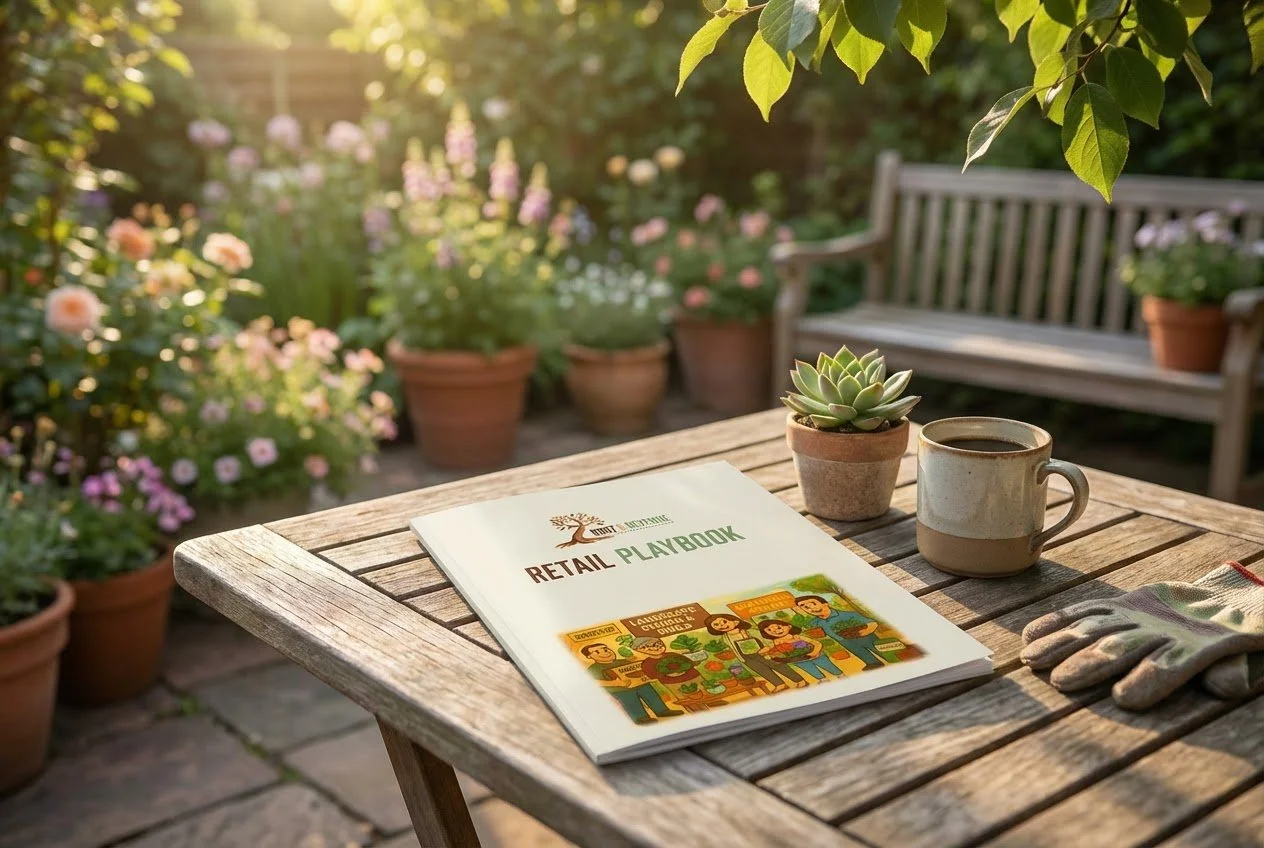
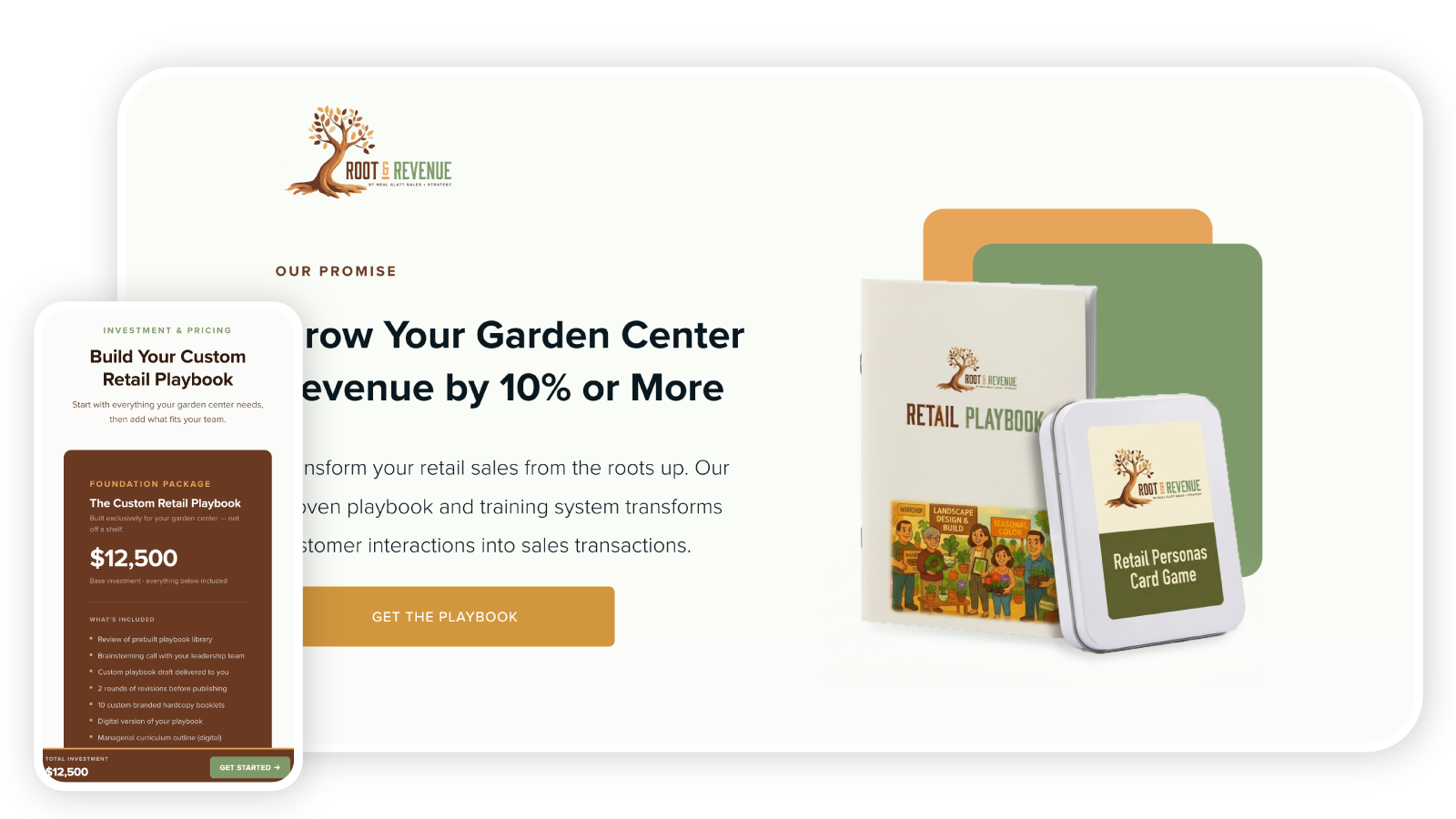
The visual identity grew from a direction identified early: a tree in a warm, earthy palette. Neal had been developing his initial playbook with illustrations in a particular color family, and the brand needed to extend that visual language rather than contradict it. The final mark centers on a stylized tree icon — organic enough to resonate with the horticultural audience, clean enough to scale across print, digital, and merchandise. The color palette draws from the earth: warm creams, deep greens, and rich leather tones. Several alternative directions were explored and presented, each with its own color system, icon, and messaging angle, letting Neal see the full spectrum of where the brand could live before choosing where it should.
“I never once felt pressured to accept a design that I didn’t like or go in a direction that felt unnatural. You made it easy to discuss those feelings and gave me peace of mind through the process.”
— Neal GlattThe Website.
The brief was a single-page experience hosted on Neal’s existing Squarespace site: one URL that could take a garden center owner from awareness to understanding to action without navigating away. The page follows a natural sales arc — naming the problem, introducing the Retail Playbook as the solution, walking through the offering in concrete terms, and landing on pricing. The copy speaks directly to plant people, using language about media, cultivation, and care not as decoration but as shared vocabulary. Most imagery was AI-generated, styled to match the brand’s earthy aesthetic — giving the brand a polished look from day one without resorting to generic stock photography.
The Calculator.
The pricing section became the technical centerpiece. Neal did not want a static pricing table. He wanted prospects to customize their package — adding extra playbook copies, training card decks, manager coaching sessions, or coverage for additional business units — and see the total investment update in real time. In effect, he wanted a storefront embedded inside a landing page.
The solution was a custom pricing calculator built with HTML, CSS, and JavaScript, injected into Squarespace as a single code block. A fixed base package sits at the top, with add-on line items that increment via quantity controls. Each adjustment recalculates the total instantly. A running summary panel sticks to the bottom of the viewport as the user scrolls — a persistent cart experience originating entirely from within one code injection. The critical piece was the data handoff: when a prospect clicks “Get Started,” their configured package details populate the inquiry form automatically, so Neal receives a complete picture of what the lead wants without requiring them to retype anything. That connection was what turned a nice interactive element into a functional sales tool.
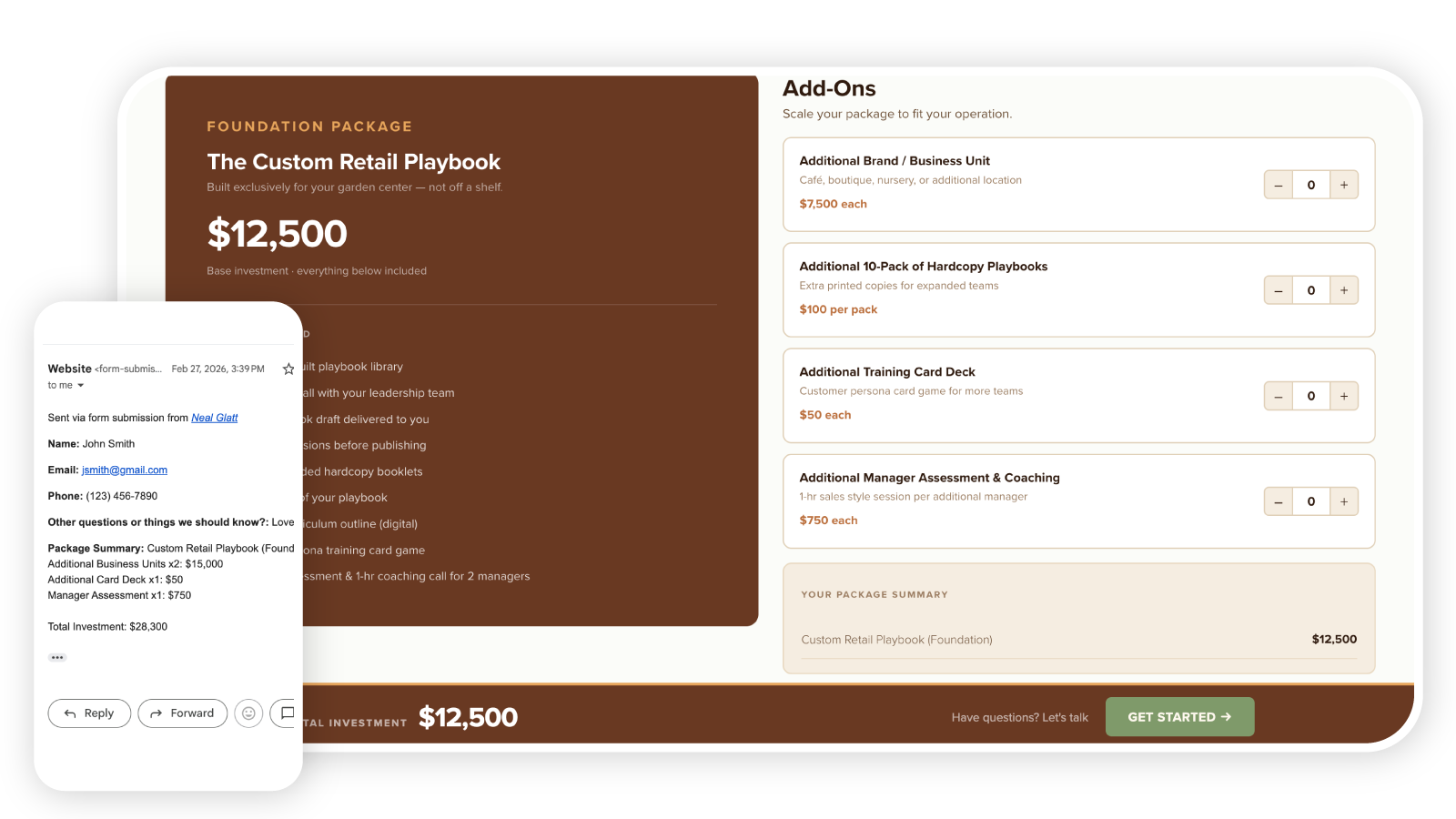
The prospect builds their package, sees the investment, and sends it to Neal in one motion.
Looking Ahead
Phase Three - Sustain
Root & Revenue was delivered as a defined engagement: naming, identity, and a launch-ready landing page. The brand now has everything it needs to operate independently — a name that communicates its value, a visual system that scales, and a digital home that converts interest into conversations. The working relationship with Neal continues, and the broader partnership across all of his brands remains active. If the program gains traction and the scope expands, the identity is built to support that growth. The foundation is there.
What Changed
From Concept to Shelf
This project did not produce a dramatic before-and-after. There was no old brand to retire, no legacy website to compare against. What existed before was an idea and the frustration that came with not being able to share it. What exists now is a product with a name, a face, and a place to live.
Root & Revenue gave Neal something tangible to point to. A prospect can now visit a single page, understand what the offering includes, build a custom package, and initiate a conversation — all without Neal needing to be in the room. For a one-person consulting practice, that kind of leverage matters. The brand does the first round of selling on his behalf.
“You worked as a sounding board and partner for a brand that I felt we created together in a way that most freelancers never bother to do.”
— Neal GlattThere is no clean revenue metric to attribute here, and I will not manufacture one. The program is early. The page is live. The brand is working. But the infrastructure is in place, and it was built to hold up.
Sometimes the hardest part of selling something is giving it a name. Once you do, the rest starts to grow.
What’s Yours?
This was their story.
Ready To Get Started?